

How Stephen Gould Scaled Its Capacity by 30% without Making a Single Hire

Campaign insights don’t drive results on their own. The difference is how quickly teams act on them.
 Casey Ciniello
4min read
Casey Ciniello
4min read
Executive Summary:
Seeing the Problem Isn’t the Hard Part Anymore
Marketing teams today are surrounded by insight.
Dashboards show campaign performance in real time.
Analytics tools surface trends instantly.
Attribution models reveal what’s working and what’s not.
For most teams, the challenge is no longer identifying problems.
It’s doing something about them — fast enough to matter in order for you to excel in marketing campaign optimizations.
Modern marketing organizations operate in an environment where visibility is no longer a constraint.
Teams can track:
Insights are everywhere.
But performance doesn’t improve just because insight exists.
Insight only creates value when it leads to action.
Despite having more data than ever, most teams struggle to move from insight to execution.
That breakdown happens in predictable ways.
Insight Is Separated from Execution
Analytics tools show what’s happening.
Execution happens somewhere else.
The connection between the two is manual.
This is especially true when teams are managing campaigns across multiple systems instead of using a structured campaign management workflow.
Delays Are Built Into the Process
Insights are often reviewed in meetings.
By the time action is discussed, days have already passed.
Ownership Isn’t Immediate
An issue is identified.
But who owns the fix?
Without clear accountability, action slows down.
Teams that implement systems like a centralized task and ownership model are able to respond significantly faster.
Context Gets Lost
Insights live in dashboards.
Tasks live in project tools.
Conversations happen in chat.
Each transition strips away context.
This is the same coordination breakdown explored in Top Campaign Management Challenges, where execution slows down as work moves across disconnected systems.
This is the core problem:
Insight → Delay → Action → Missed Impact
The longer the delay between identifying a problem and acting on it, the less effective the response becomes.
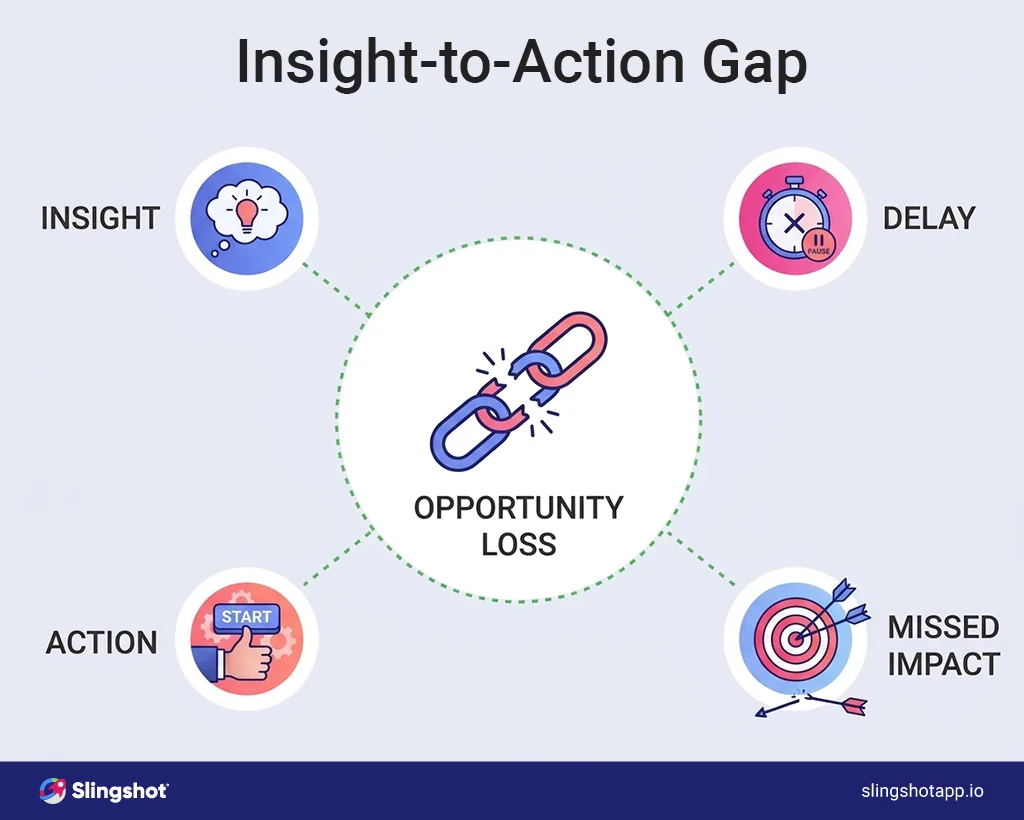
This is the Insight-to-Action Gap.
And it exists in nearly every marketing organization.
This gap doesn’t just affect operations.
It affects performance.
Missed Optimization Windows
Opportunities to improve campaigns pass before action is taken.
Wasted Budget
Inefficiencies continue longer than they should.
Slower Pipeline Growth
Campaign performance directly impacts revenue outcomes.
Teams that connect execution directly to revenue tracking — like those using a sales pipeline tracking system — can respond faster to performance changes.
Reduced Team Efficiency
Teams spend more time coordinating work than executing it.
Execution speed becomes the limiting factor.
The best teams don’t just generate insights.
They act on them immediately.
They:
They reduce the time between seeing a problem and fixing it.
Turning insight into impact requires a system.
Not more dashboards.
A system that connects:
Insight → Owner → Action → Measured Outcome
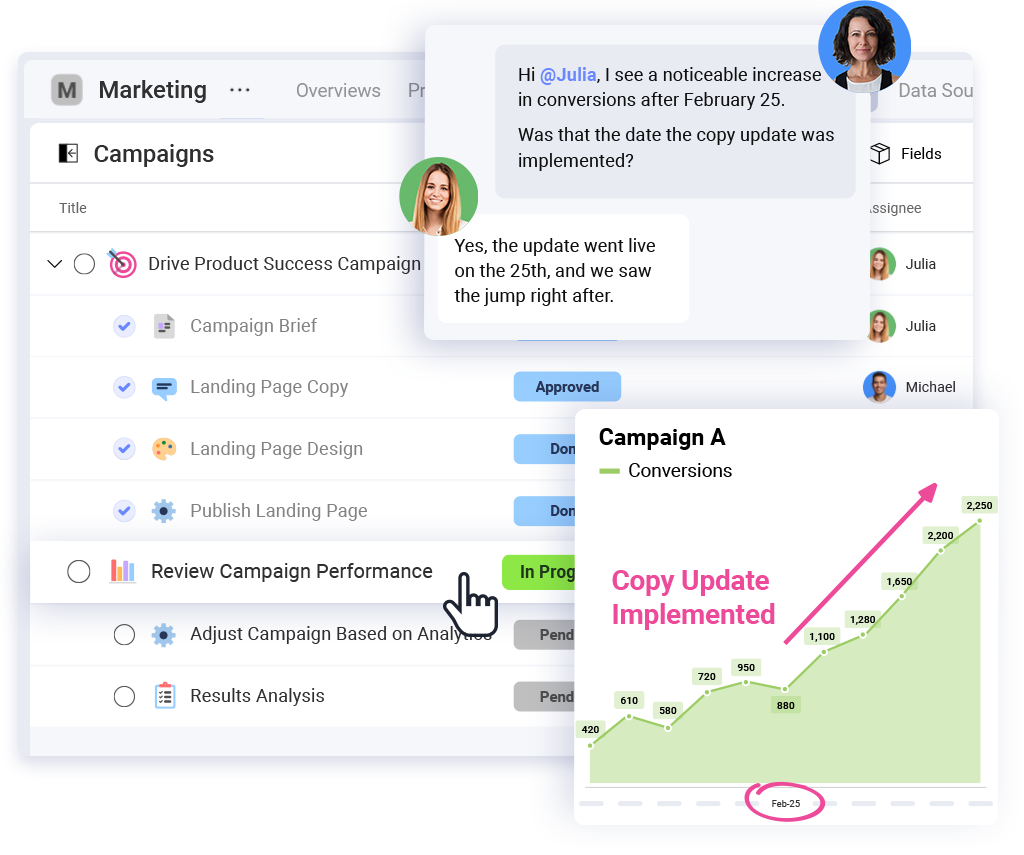
When a performance signal appears:
No delays. No disconnect.
Most teams try to fix this by adding more tools.
But the problem isn’t a lack of tools.
It’s how those tools are connected.
Execution-connected systems eliminate the gap by design.
Platforms like Slingshot bring together:
So, teams can move from insight to action without losing context.
If your team is managing campaigns across disconnected tools, exploring a unified marketing execution system can dramatically reduce delays and improve performance.
Marketing teams don’t struggle because they lack insight.
They struggle because insight doesn’t translate into action fast enough.
The teams that win aren’t the ones with the most data.
They’re the ones that act on it fastest.
See how Slingshot connects performance data directly to execution so your team can move faster and drive better results.
SHARE THIS POST


 Return to Blog
 ChatGPT
 Perplexity