

How Stephen Gould Scaled Its Capacity by 30% without Making a Single Hire

Dashboards don’t improve performance — they only show it. The real difference comes from how teams coordinate action.
 Casey Ciniello
7min read
Casey Ciniello
7min read
Executive Summary:
Dashboards Show You the Problem. They Don’t Fix It.
Marketing teams have more dashboards than ever.
Every metric is visible. And yet marketing performance doesn’t automatically improve.
Because dashboards don’t drive results.
Action does.
The real gap isn’t visibility. It’s the space between the signal on the dashboard and the action your team actually takes: the Signal → Action gap.
So, do dashboards improve performance? Well, they improve what you can see, but performance only improves when insights trigger coordinated execution.
Over the past decade, marketing teams have invested heavily in visibility.
Dashboards now show:
This has solved one problem: not knowing what’s happening.
But it hasn’t solved the next one: acting on it fast enough. That’s why so many teams feel the disconnect between strong marketing analytics and weak execution.
Dashboards are powerful but incomplete.
They Don’t Trigger Action
A metric drops, the dashboard shows it clearly, but action doesn’t happen immediately.
Instead, it gets reviewed…later. Visibility without an immediate next step keeps teams stuck in reporting mode instead of performance mode.
They Don’t Assign Ownership
Who is responsible for fixing the issue? Dashboards don’t answer that. Without ownership, execution slows. Someone has to own the response, not just the report.
They Don’t Connect to Execution
The insight exists. But the work required to fix it lives somewhere else.
Teams using a structured campaign execution system can move faster because insights are directly tied to action. A drop in performance doesn’t just go unnoticed; it automatically becomes owned work in a shared system.
They Introduce Delays
Insights are often reviewed in:
By the time action is taken, the opportunity has already passed. This is where the Signal → Action gap shows up in practice: dashboards surface the signal immediately, but your systems and processes delay the action
This is the core issue:
Dashboard → Insight → Delay → Action
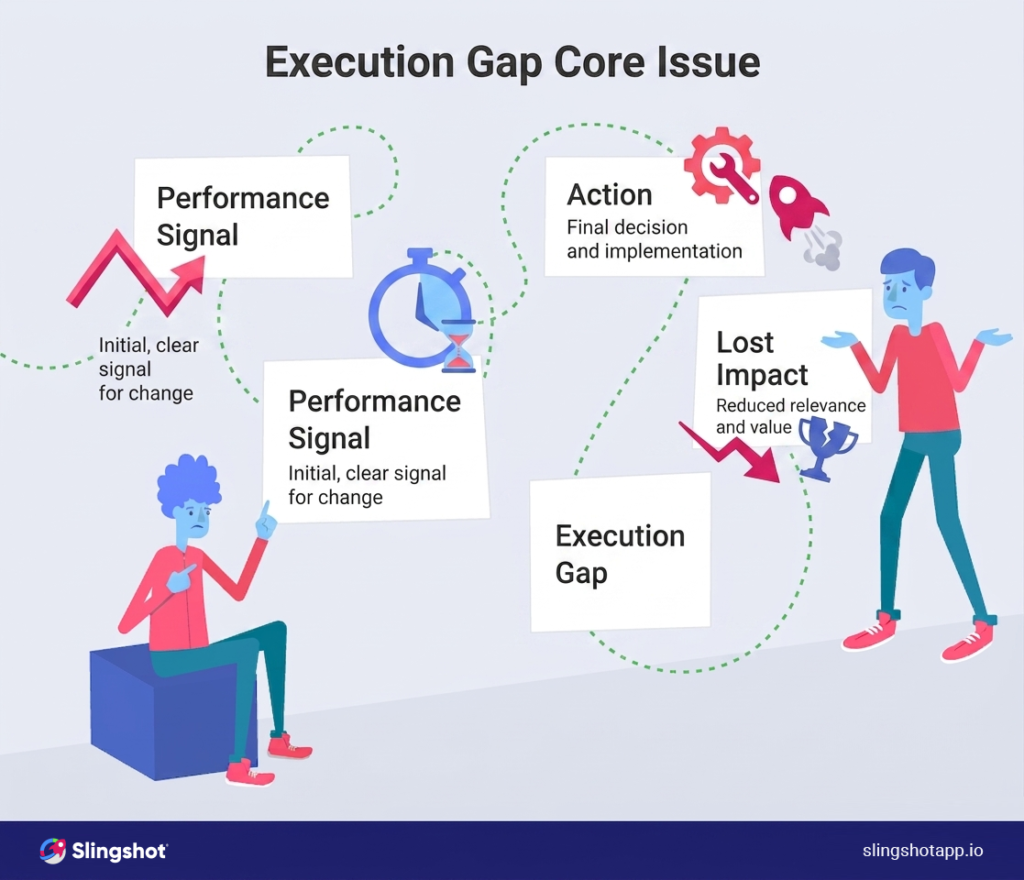
Every step introduces friction.
This is the same breakdown explored in the Top Campaign Challenges, where execution slows as work moves across disconnected systems and every handoff expands the Signal → Action gap.
Dashboards are just one part of the performance story. The rest of the story lies in how quickly insights become owned and coordinated work.
In other words, the difference between marketing dashboards and performance is not a data problem. It’s an execution workflow problem.
Top-performing teams don’t stop at insight.
They act immediately.
They:
They reduce the time between:
Insight → Action
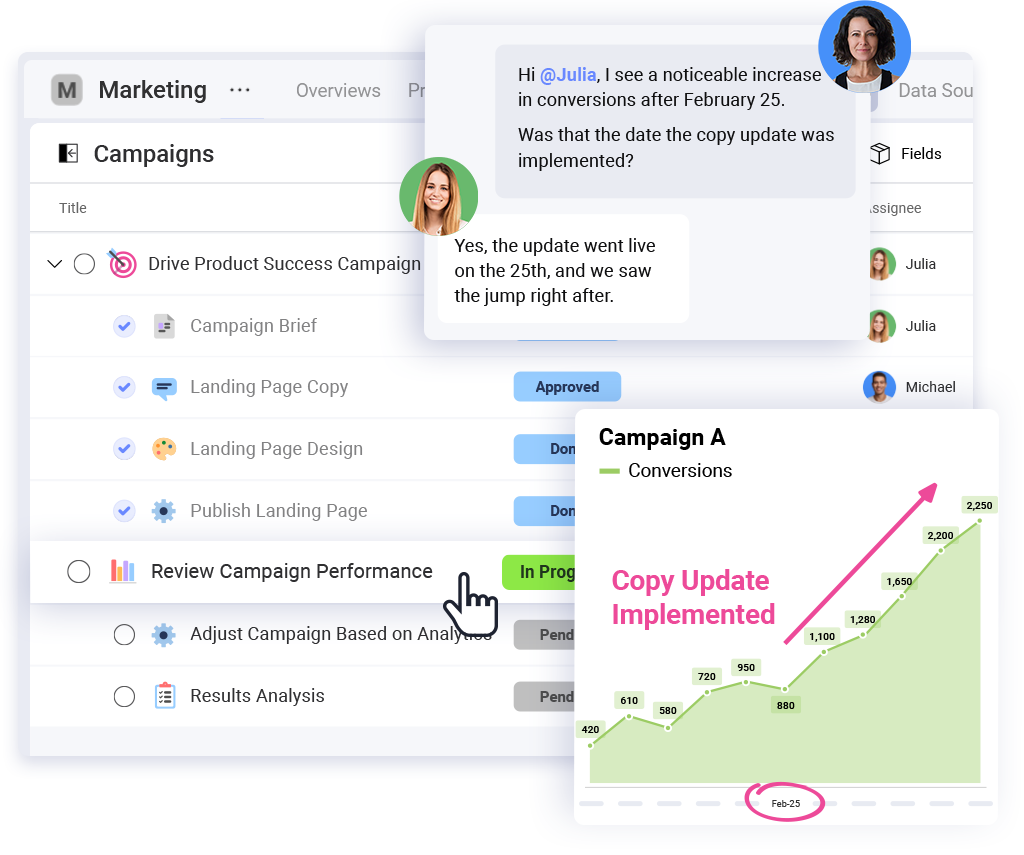
For example, when a paid campaign’s CPL spikes, a high-performing team doesn’t wait for the weekly review. The dashboard signal immediately creates a task, assigns an owner, and outlines the optimization steps in the same system where the work happens.
This tight loop between data and execution is what turns analytics into performance, not just visibility.
Improving performance requires a shift.
From: Dashboard → Insight → Delay
To: Insight → Owner → Action → Result
This is where performance is actually driven.
Teams that implement structured systems, like an SEO management workflow, can move faster from insight to execution. Instead of using separate reporting, planning, and execution tools, the full campaign performance optimization process runs in a single place.
The pattern is the same across paid media, SEO, and lifecycle campaigns: the teams that win connect performance signals directly to owned work and tight execution workflows.
Adding more dashboards won’t solve the problem.
Connecting dashboards to execution will.
Execution-connected systems bring together:
So, teams can act on insights immediately.
If your team is already working to improve how insights turn into action, this is the same system outlined in From Insight to Action for Marketing Campaign Optimization.
This is exactly what Slingshot is designed to do: connect performance data, execution workflows, and clear ownership so every signal can trigger coordinated action.
With Slingshot, your dashboards don’t just show performance. They automatically create, assign, and track the work required to improve it across paid media, SEO, and other key programs.
Dashboards don’t improve performance. They expose it.
The teams that win are the ones that act on what they see, faster than everyone else.
The advantage now belongs to the teams that close the Signal → Action gap not by adding more dashboards, but by connecting their dashboards to coordinated execution.
See how Slingshot connects performance data to execution so your team can move faster and improve results.
Dashboards improve visibility into what’s working and what isn’t, but they don’t improve performance on their own. Performance improves when insights are connected to clear ownership and coordinated action in a shared execution system.
Dashboards show you performance, but they don’t assign owners, define next steps, or connect insights to the workflows where work actually happens. Without that connection, most teams stay stuck in reporting cycles instead of closing the signal-to-action gap.
Marketing performance improves when teams act quickly on insights. This requires clear ownership, defined next steps, and a system that connects data directly to execution so teams can respond in real time.
Reporting shows what has happened, but it doesn’t ensure anything changes. Without a system that connects insights to action, teams review performance without improving it.
SHARE THIS POST


 Return to Blog
 ChatGPT
 Perplexity