

How Stephen Gould Scaled Its Capacity by 30% without Making a Single Hire

Dashboards aren’t enough. Learn how to build a marketing reporting system that connects insights to execution.
 Casey Ciniello
11min read
Casey Ciniello
11min read
Executive Summary:
Dashboards Show You What’s Happening. They Don’t Change It.
Most marketing teams already have a marketing reporting system in place. The issue is not whether reporting exists. The issue is whether it is built to drive action.
In many cases, reporting is centered on dashboards.
Everything is visible. Teams can see performance across channels, campaigns, and funnel stages. Metrics are tracked in real time. Reports are accessible.
But performance still does not improve at the pace teams expect.
The reason is simple.
Dashboards show what is happening, but they do not tell teams what to do next.
If your marketing reporting system stops at visibility, it will not improve outcomes. It will only document them.
This is why understanding the difference between reporting and execution matters. If you haven’t read it yet, this is exactly why Dashboards Don’t Improve Performance. Coordinated action does.
The real bottleneck is how quickly teams turn insight into action.
Dashboards solve one problem: visibility across performance. They provide a snapshot of performance across campaigns, channels, and pipeline stages. They help teams monitor trends, identify changes, and review historical data.
But a marketing reporting process that relies only on dashboards creates gaps that slow teams down. Dashboards don’t answer:
Even a well-built paid performance dashboard only highlights what is happening. It does not guide what should happen next.
As a result, teams spend more time reviewing reports than resolving issues. Reporting becomes passive instead of operational.
A marketing reporting system is more than a collection of dashboards. It is an operational structure that connects data to decisions, ownership, and execution.
At its core, a system links:
Data → Insight → Owner→ Action → Outcome
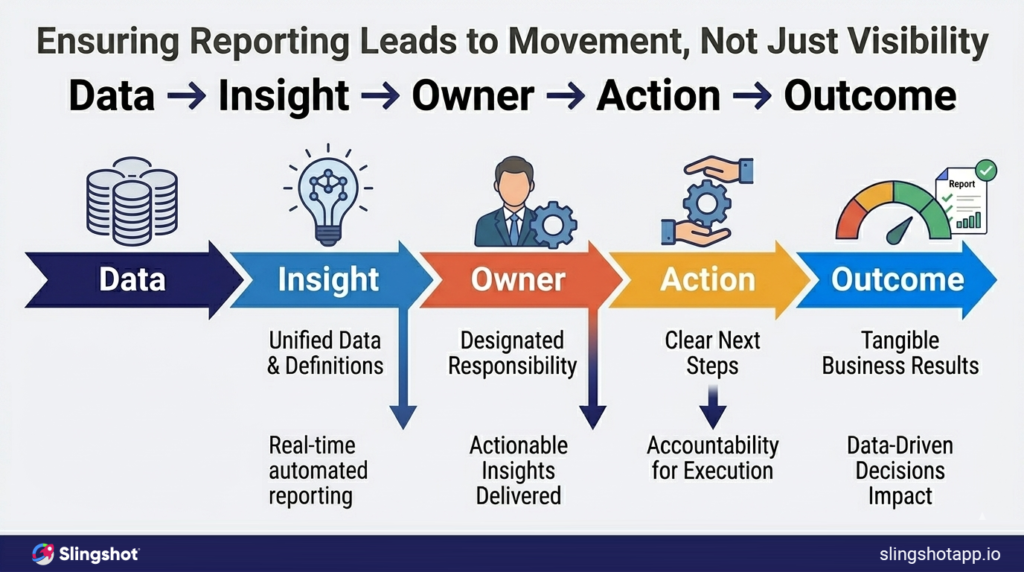
This structure ensures that reporting leads to movement, not just visibility.
The distinction matters.
In a system, when data changes, it triggers a response. Insights trigger ownership. Ownership triggers action. Action drives outcomes.
A strong campaign reporting system does not separate reporting from execution. It integrates them into a single flow.
Most teams think reporting starts and ends with dashboards. But dashboards are only one piece of a much larger marketing analytics workflow.
A true marketing reporting system connects performance data to execution, so insights do more than inform decisions. They trigger action
At a high level, every effective reporting system includes four components:
1. Centralized Data
All performance data must live in one place.
That includes:
When data is scattered across multiple tools, teams spend time reconciling numbers instead of analyzing them. This creates delays and introduces inconsistencies.
Centralization allows teams to:
This is where many teams rely on tools like a paid performance dashboard, but dashboards alone only solve visibility, not execution.
2. Clear, Actionable Insights
Not all metrics are useful.
A reporting system focuses on the signals that actually drive decisions and actions:
The goal isn’t to track everything; it’s to identify what requires action.
A marketing reporting process that lacks this focus leads to information overload. Teams spend time reviewing data that does not change behavior.
Actionable insights reduce ambiguity and help teams prioritize.
3. Defined Ownership
Insights without ownership don’t lead to action.
Every signal must answer:
Without clear ownership, reporting becomes passive. With ownership, it becomes operational. Each insight is linked to the person responsible for execution.
4. Connected Execution
This is where most systems break down.
Even when teams have centralized data, clear insights, and defined ownership, execution often happens outside the reporting environment.
A true reporting system connects insights directly to workflows, and insights automatically translate into tasks, updates, or actions.
Teams using a campaign execution workflow can move from identifying an issue to resolving it without switching contexts.
Connected execution ensures that reporting does not end with analysis. It continues through action and outcome.
Most organizations have some version of these components.
But they exist in separate tools:
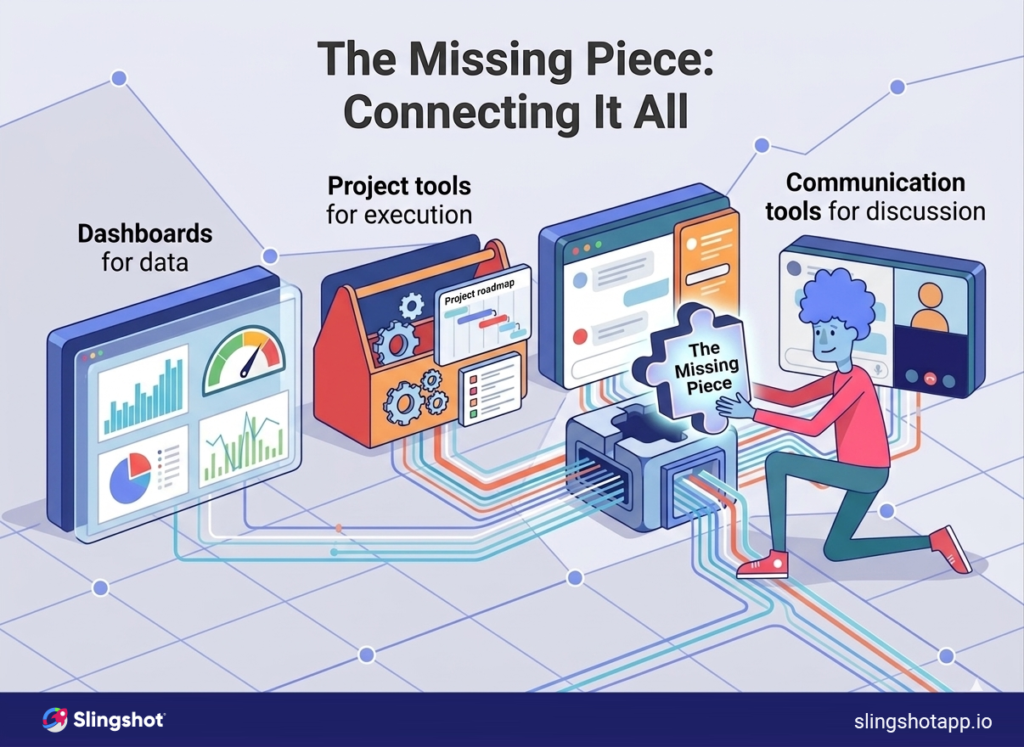
That fragmentation slows teams down and creates gaps between insight and execution.
A real reporting system connects all four components into a single workflow where data flows into insights, insights trigger ownership, ownership drives execution, and execution feeds outcomes.
They focus on dashboards.
Instead of systems.
Reporting becomes:
Data becomes easier to access, but harder to act on. Without a system that connects reporting to execution, insights remain isolated from outcomes.
The core issue is not a lack of data, but a lack of connection between data and action.
They treat reporting as an operational system.
They:
They close the gap between insight, ownership, and action. This is the same system outlined in From Campaign Insight to Campaign Action.
High-performing teams build feedback loops where every insight is tied to a measurable response and outcome.
Building a marketing reporting system requires shifting from tracking data to operationalizing it. Here is how to structure it:
Most teams don’t need better dashboards. They need better systems.
A unified marketing execution system connects:
So, insights lead directly to action. Explore how Slingshot supports a unified marketing execution system.
Marketing performance isn’t limited by visibility. It’s limited by execution speed.
The teams that win aren’t the ones with the best dashboards. They’re the ones that act on them fastest.
If your reporting isn’t improving performance, the issue isn’t visibility. It is execution.
Slingshot connects data, ownership, and workflows in one system so your team can move faster from insight to action.
To connect data to execution so your team can act on insights quickly and improve performance. It moves reporting from passive tracking to active decision-making.
Dashboards display data. A marketing reporting system connects that data to ownership, actions, and outcomes. Dashboards inform. Systems drive execution.
Yes. Dashboards are still useful for visibility. They become more effective when they are part of a system that links insights to workflows and actions.
They stop at visibility. They do not assign responsibility, define next steps, or trigger execution. This creates a gap between insight and action.
A complete system includes centralized data, clear actionable insights, defined ownership, and connected execution. These components work together to turn reporting into a workflow.
It reduces fragmentation across tools, eliminates manual reconciliation, and allows teams to analyze performance faster and with fewer errors.
An insight that clearly signals a change, ties to a specific metric, and points to a decision or action a team can take.
Ownership ensures accountability. Every insight has someone responsible for responding to it, which prevents delays and missed actions.
It links reporting directly to workflows so insights can trigger tasks, updates, or notifications without switching tools or waiting on manual handoffs.
Focus on metrics that influence decisions and behavior, such as conversion rates, cost per acquisition, pipeline contribution, and campaign performance trends.
It depends on campaign activity, but most teams review weekly for performance tracking and monthly for strategic evaluation. Active campaigns may require more frequent reviews.
You should see faster response times, clear ownership for insights, consistent execution, and measurable improvements tied to specific actions.
Treating reporting as a visualization problem instead of an operational one. This leads to more dashboards but no improvement in execution speed.
Start by defining the metrics that drive decisions, then centralize data, assign ownership, connect reporting to workflows, and track outcomes from actions taken.
SHARE THIS POST


 Return to Blog
 ChatGPT
 Perplexity