

How Stephen Gould Scaled Its Capacity by 30% without Making a Single Hire

Most marketing teams report activity—not revenue. Revenue accountable marketing connects campaigns, pipeline, and outcomes so teams can prove impact and drive growth.
 Casey Ciniello
7min read
Casey Ciniello
7min read
Executive Summary:
At first, the conversation focused on visibility. Dashboards. Campaign reports. Attribution models. The goal was to show activity and engagement.
But executive expectations have changed.
Today, leadership doesn’t ask how many campaigns were launched or how many leads were generated. They ask a much harder question:
How is marketing contributing to revenue?
That shift is what gave rise to the concept of revenue accountable marketing.
Yet despite the phrase becoming popular, many organizations still struggle to implement it. Marketing teams continue to track performance in fragmented systems, relying on disconnected dashboards and manual reporting to explain their results.
Understanding what revenue-accountable marketing actually looks like requires moving beyond reporting and into how marketing operations are structured and how a true revenue marketing strategy is put into practice.
Traditional marketing performance models were built around activity metrics.
Common measures included:
These metrics helped marketing teams measure productivity, but they didn’t fully explain business impact.
As SaaS and subscription-based businesses grew, leadership began evaluating marketing differently.
Instead of activity metrics, organizations began asking questions like:
Answering these questions requires connecting marketing activity to the revenue engine. That is the foundation of revenue accountable marketing and a more meaningful model of marketing accountability tied directly to pipeline and revenue.
Many marketing teams still rely on metrics that stop short of revenue insight.
For example:
This creates a common problem during executive reporting.
Marketing leaders present dashboards showing traffic, conversions, and campaign engagement. But leadership asks a different question entirely:
How did marketing impact revenue this quarter?
Without a clear system connecting marketing activity to pipeline and revenue, the answer often requires manual reporting, cross-referencing CRM data, and building slide decks before leadership meetings.
This process is slow, fragile, and difficult to scale.
Revenue-accountable marketing requires a more structured system that makes marketing contribution to pipeline visible in real time, not just at the end of the quarter.
Many teams try to close the gap with manual spreadsheet reporting or one-off reporting builds, like creating a marketing KPI dashboard template in a BI tool. However, those artifacts still sit outside the actual revenue engine and quickly become outdated.
Revenue-accountable marketing is not simply better reporting.
It is a different operational model.
High-performing SaaS marketing teams typically share five characteristics.
1. Pipeline Contribution Is a Core Marketing Metric
In revenue-accountable organizations, marketing performance is evaluated by its influence on pipeline creation and revenue.
Marketing dashboards track:
This allows leadership to see how marketing programs impact the sales pipeline, making marketing pipeline accountability a primary lens for performance conversations.
2. Marketing and Sales Data Are Connected
Revenue accountability requires a shared view of the customer journey.
Marketing activity, CRM data, and sales pipeline information must work together. Without integration across these systems, marketing performance becomes fragmented.
Many organizations attempt to bridge this gap using spreadsheets or manual reporting. However, this approach often leads to inconsistencies in pipeline numbers and attribution logic.
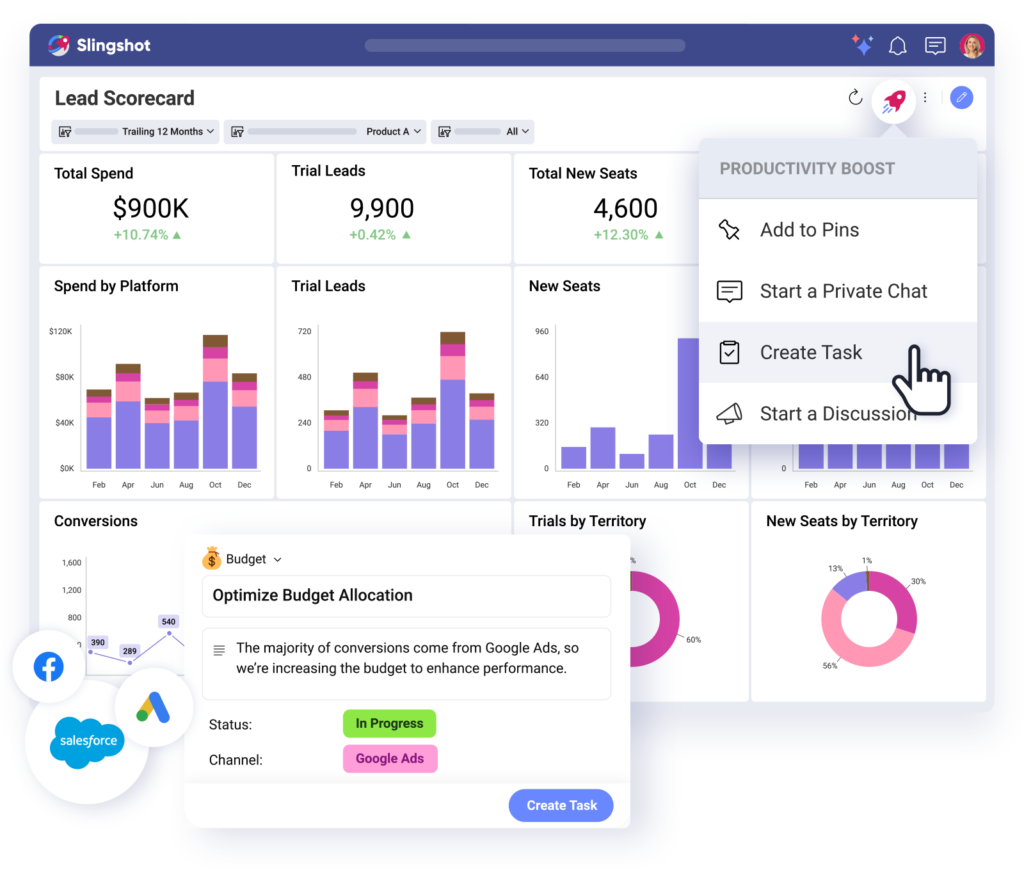
A unified marketing analytics platform like Slingshot enables alignment of marketing activity with sales outcomes in a single view. It defines consistent rules for how marketing contributes to the pipeline, and it measures that contribution.
3. Marketing Performance Is Reviewed Continuously
Revenue-accountable marketing is not limited to monthly reporting. High-performing teams monitor marketing performance continuously.
Weekly performance reviews often focus on questions such as:
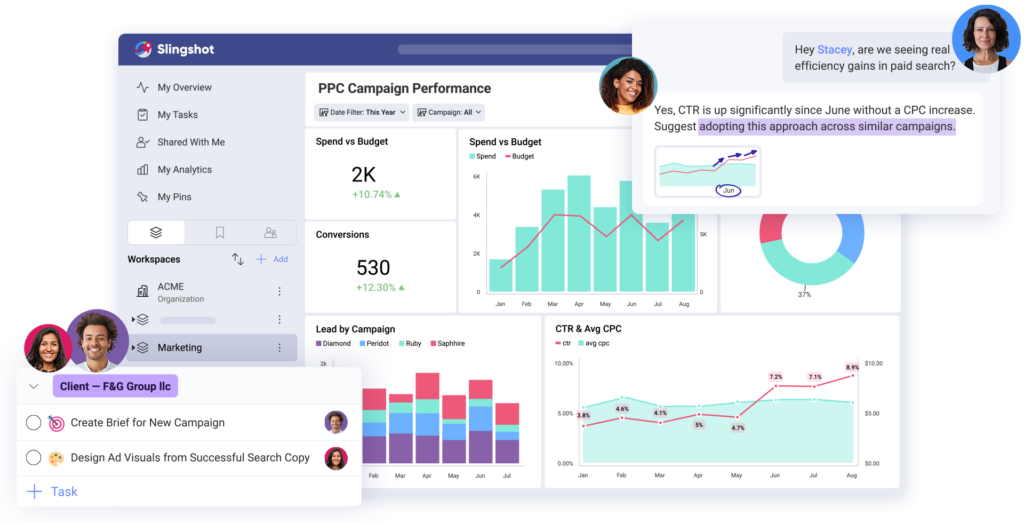
This operational rhythm allows marketing teams to adjust quickly rather than react after performance issues become visible, turning revenue-accountable marketing from a reporting exercise into an ongoing operating cadence.
4. Performance Insights Connect Directly to Execution
Many marketing organizations track performance in dashboards but manage execution elsewhere.
For example:
Analytics platforms display performance metrics, but campaign execution lives in project management tools.
This separation creates a delay between insight and action.
Revenue-accountable teams close that gap.
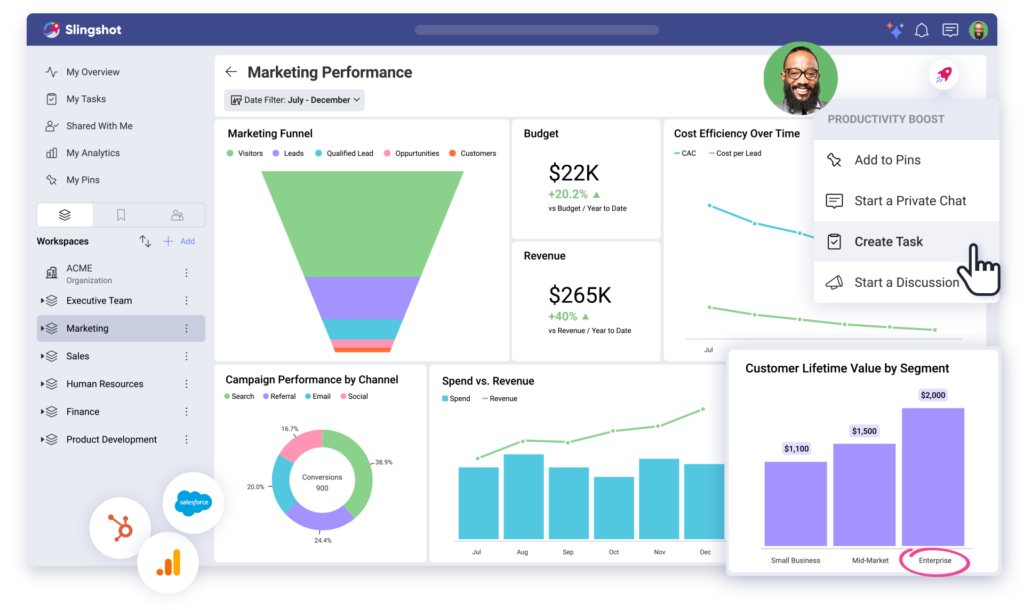
When performance signals change, teams quickly assign follow-up actions:
Connecting insights directly to execution helps teams respond faster to performance trends and brings revenue marketing strategy, planning, and performance into a single loop.
5. Marketing Leadership Can Clearly Explain Performance
One of the clearest indicators of revenue accountability is how easily marketing leaders can explain performance to executives.
In mature organizations, marketing leaders can quickly answer questions like:
Instead of rebuilding reports before every leadership meeting, teams rely on trusted performance systems.
This improves confidence in marketing results and strengthens alignment between marketing and executive leadership because every conversation starts from a shared, trusted view of marketing’s impact on pipeline and revenue.
Many companies assume revenue accountability is primarily a reporting challenge. They invest in dashboards or analytics tools, expecting greater visibility to solve the issue.
However, dashboards alone do not create accountability. They simply visualize data.
Without an operational structure, dashboards can still leave teams asking:
Revenue-accountable marketing requires integrating data, execution, and ownership into a single operational system rather than stitching together a series of isolated reports and tools.
Organizations that succeed with revenue-accountable marketing typically build systems that combine three elements:
Performance visibility
Marketing teams need reliable access to pipeline and revenue metrics. This means connecting core source systems, CRM, marketing automation, ad platforms, and product data into a single view that reflects how marketing actually drives opportunities and revenue.
Operational workflows
Marketing activity, campaign planning, and optimization work must be coordinated across the team.
Clear ownership
Every initiative should have a defined responsibility and measurable outcomes, so the same system that surfaces insights can also manage experiments, campaigns, and follow-up actions.
When these components are connected, marketing performance becomes easier to understand and improve.
Instead of reacting to performance problems after they occur, teams can identify trends earlier and respond with coordinated action grounded in a clear revenue marketing strategy and shared accountability for pipeline.
Most teams try to assemble this system from multiple tools: analytics, spreadsheets, project management, and CRM views, which leads to the pipeline reporting challenges many marketing leaders recognize: conflicting numbers, slow ad hoc analysis, and time-consuming prep before every executive meeting.
A platform like Slingshot brings performance visibility, operational workflows, and ownership into one place, so marketing leaders can see pipeline and revenue impact, prioritize work, and track outcomes without jumping between disconnected systems.
If you’re beginning this journey, a practical starting point is to define the handful of metrics that matter most for revenue-accountable marketing (such as marketing-sourced pipeline, influenced pipeline, and conversion velocity), then configure a marketing KPI dashboard template around those metrics in a system that also supports campaign planning and execution.
As SaaS businesses continue to scale, marketing expectations will only increase. Executives want clarity around how marketing investments translate into pipeline and revenue growth.
Marketing teams that rely on disconnected reporting systems will struggle to provide that clarity.
Those that adopt revenue-accountable marketing models will be able to connect strategy, execution, and performance in one measurable system where marketing pipeline accountability is built into how the team plans, reports, and makes decisions every week.
The result is a marketing organization that not only drives growth but can clearly demonstrate how it happens and proves, with confidence, exactly how marketing contributes to pipeline and revenue.
Slingshot is built to support that model: giving marketing leaders a unified marketing analytics platform, shared KPI dashboards, and an execution workspace that ties every program back to pipeline and revenue impact.
SHARE THIS POST



 Return to Blog
 ChatGPT
 Perplexity