How Stephen Gould Scaled Its Capacity by 30% without Making a Single Hire

Marketing teams don't have a visibility problem anymore.
They have a response problem.
Today's marketing organizations can see performance issues faster than ever. Dashboards surface shifts in campaign performance, pipeline contribution, and conversion rates in near real time.
But seeing a problem and fixing it are two very different things.
Across organizations, the same pattern repeats:
A performance issue appears. It gets discussed. Actions are identified. And yet, meaningful change happens too late — after the impact has already hit pipeline and revenue.
This is what we call the Signal-to-Action Gap — the delay between when a performance signal is identified and when coordinated action is taken.
This paper explains why that gap exists, what it costs marketing teams, and how high-performing organizations are closing it.
Fill out the form to continue reading
Over the past decade, marketing technology has dramatically improved visibility into performance.
Teams now have access to dashboards that track:
This level of visibility has fundamentally changed how marketing operates.
Leaders no longer have to guess what's happening. They can see performance clearly.
But visibility alone doesn't improve outcomes.
Many organizations have unknowingly traded one challenge for another.
They can identify performance issues quickly — but responding to those issues is where the system breaks down.
In most organizations, the journey from insight to execution looks like this:
Results are checked — weeks later, after the impact has already compounded.
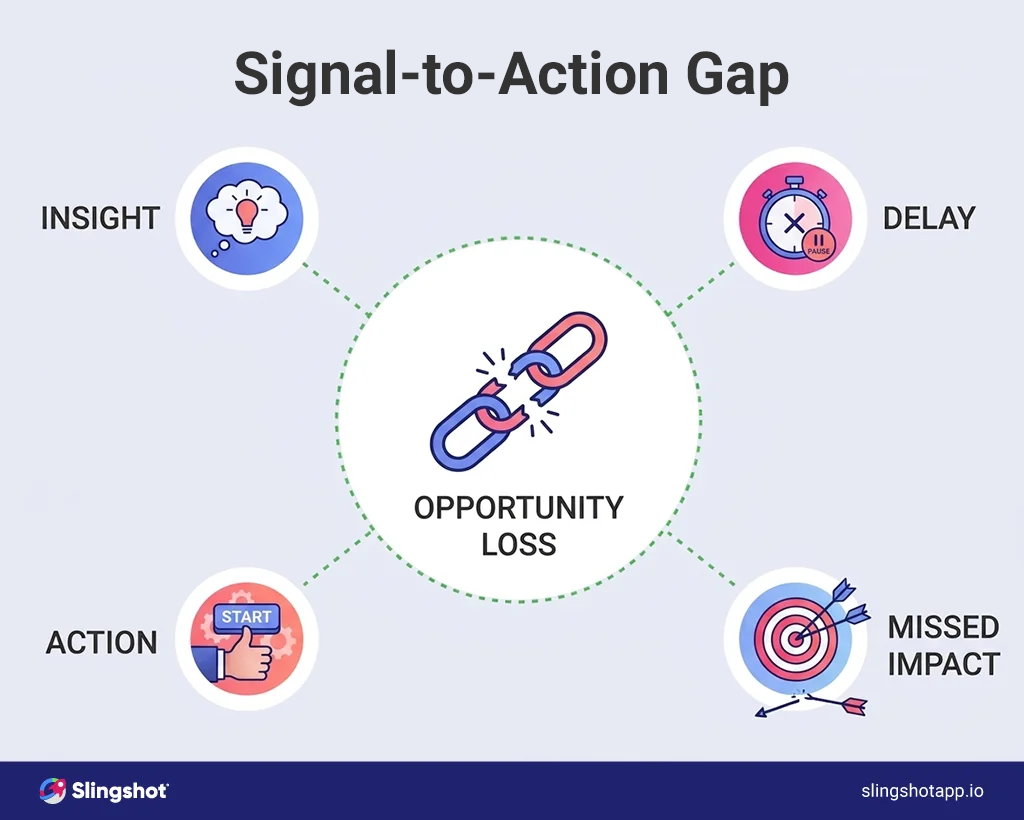
At each step, friction is introduced.
The connection between them is manual — and fragile.
The result is predictable:
The insight gets acknowledged, discussed, and then slowly loses momentum as it moves across tools and teams.
This is the Signal-to-Action Gap — and it exists in nearly every marketing organization.
The impact of this gap is not abstract. It shows up in measurable ways across marketing performance.
Slower Optimization Cycles
Teams respond to performance issues days or weeks after they appear, reducing the effectiveness of campaign adjustments.
Fragmented Accountability
Ownership of follow-up actions becomes unclear as work moves across systems and teams.
Reduced Confidence in Reporting
Executives question why known issues were not addressed sooner, even when visibility was clear.
Inefficient Marketing Operations
Teams spend more time coordinating next steps than executing improvements.
Individually, these issues seem manageable. Together, they compound into slower execution, wasted spend, and missed revenue opportunities.
High-performing marketing teams don't treat performance signals as passive insights.
They treat them as operational triggers.
Closing the Signal-to-Action Gap requires a system that enables insights to drive immediate, coordinated execution.
A modern Signal-to-Action Framework includes four components:
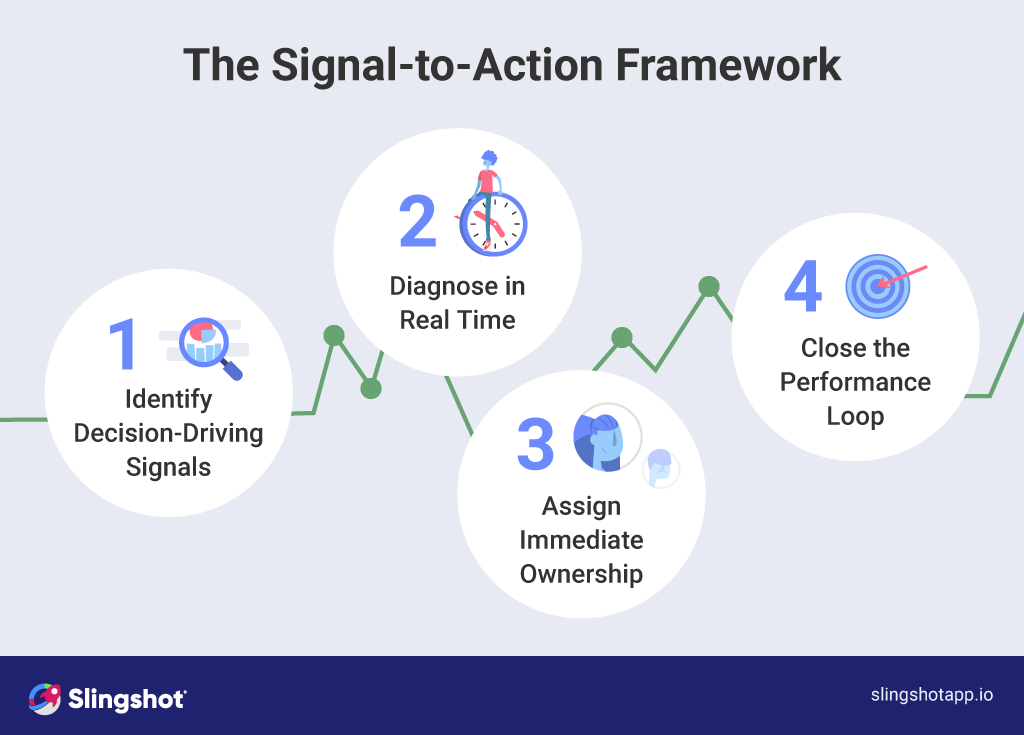
1. Identify Decision-Driving Signals
Not all metrics require action. High-performing teams focus on the signals that directly influence outcomes, such as:
When these signals shift, they trigger immediate investigation — not a delayed discussion.
2. Diagnose in Real Time
Speed of diagnosis determines speed of response.
Teams need a structured way to quickly assess:
This step should take hours, not days.
3. Assign Immediate Ownership
Once the root cause is identified, action must be clear and accountable.
Examples include:
Every action must have:
Execution speed is driven by accountability.
4. Close the Performance Loop
After actions are implemented, teams must track their impact relative to the original signal.
This step transforms isolated fixes into organizational learning.
It ensures teams don't just react — they improve their ability to respond faster over time.
The framework itself is not complex.
The challenge lies in how marketing systems are structured.
Most organizations operate across disconnected tools:
These systems do not share context.
As a result, teams are forced to manually bridge the gap:
This manual coordination introduces friction.
Friction introduces delay.
And delay directly impacts performance.
Closing the Signal-to-Action Gap requires more than better dashboards.
It requires connecting performance insights directly to execution workflows.
This is the foundation of execution-connected analytics.
Platforms like Slingshot are designed around this principle.
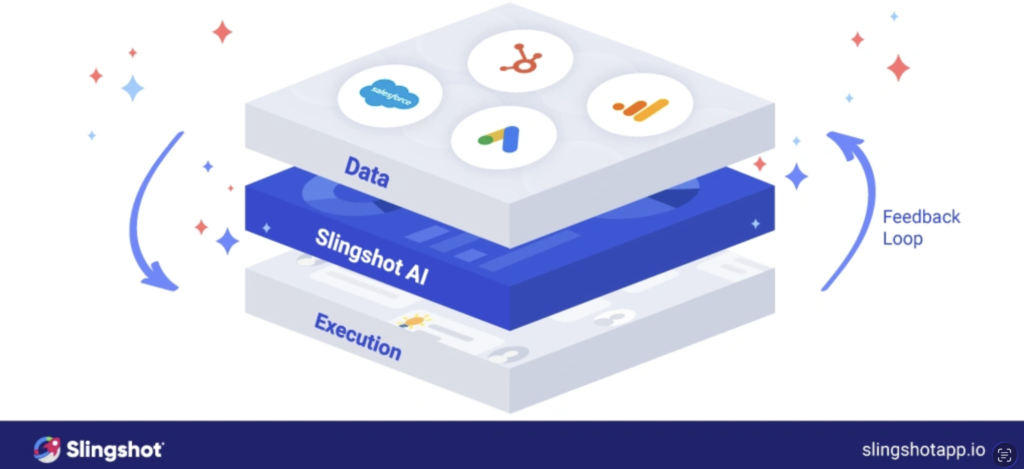
Instead of separating data, work, and collaboration, Slingshot brings them into a single workspace where insights and actions exist together.
There is no handoff between identifying a problem and acting on it — the system itself becomes the bridge.
Specifically, Slingshot connects:
The result is simple but powerful:
When a metric changes, action happens immediately — with full context and clear ownership.
The difference between disconnected systems and execution-connected analytics is most visible in how teams respond to change.
Before
Performance dips → weekly meeting → discussion → task created in a separate tool → follow-up scattered across conversations → results reviewed weeks later
After
Performance dips → signal identified in real time → root cause discussed in context → task created and assigned immediately → progress tracked against the original KPI → results measured within days
That speed difference compounds.
Teams that operate on faster optimization cycles:
As marketing organizations mature, execution speed becomes a competitive advantage.
The teams pulling ahead are not the ones with the most data.
They are the ones that act on it fastest.
By closing the Signal-to-Action Gap, teams can:
This is the shift from reporting on performance to actively driving it.
Modern marketing teams are not limited by a lack of data.
They are limited by how their systems translate insight into action.
The Signal-to-Action Gap slows execution, fragments accountability, and reduces the impact of even the best insights.
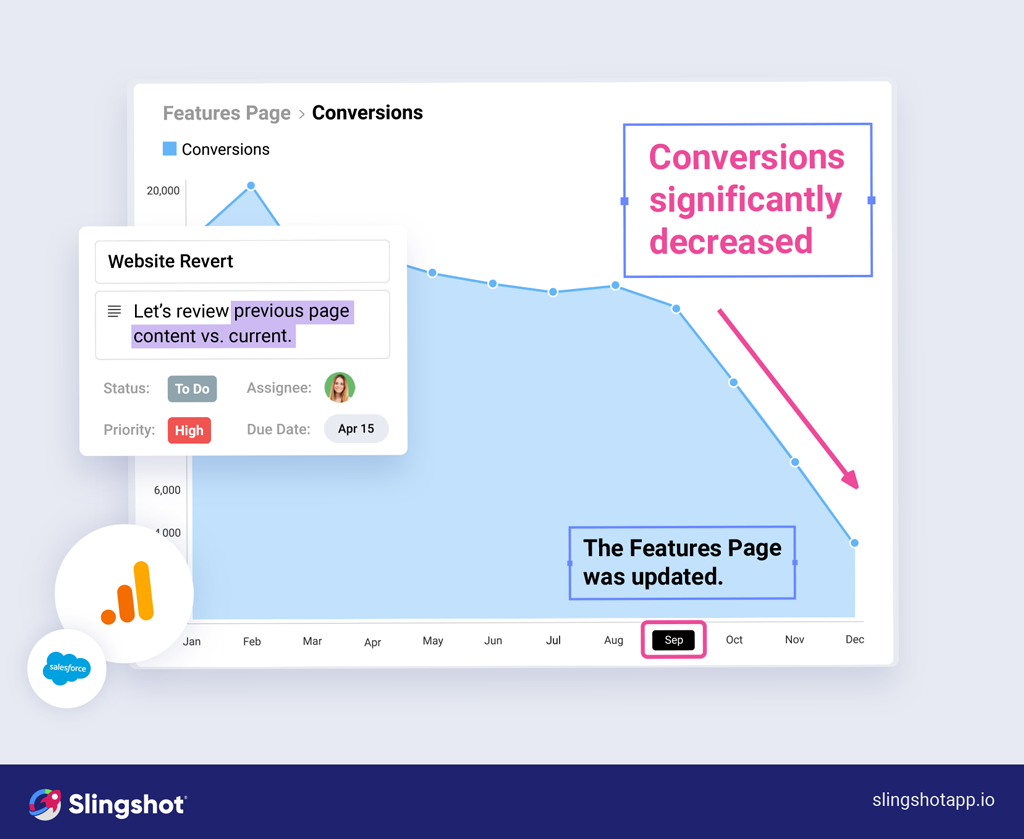
Closing that gap requires more than better visibility.
It requires systems that connect performance signals directly to coordinated action.
The organizations that solve this will not just operate more efficiently — they will outperform competitors through faster, more consistent execution.
Because in modern marketing, insight is no longer the advantage.
Execution speed is.
See How Leading Marketing Teams Close the Signal-to-Action Gap
Discover how Slingshot connects performance insights directly to coordinated action so your team can move faster, stay aligned, and drive measurable results.