

How Stephen Gould Scaled Its Capacity by 30% without Making a Single Hire

Most SEO strategies fail after planning. Learn why content teams struggle to execute and how to build a workflow that consistently turns keywords into published, optimized content.
 Casey Ciniello
7min read
Casey Ciniello
7min read
Executive Summary:
Key Takeaways:
Every SEO plan looks solid at the start.
You’ve got your keyword list, your content ideas, and a clear sense of what should drive traffic. But a few weeks later, nothing has shipped.
The problem isn’t the plan. It’s what happens after it’s made.
And then everything slows down.
SEO doesn’t break at the strategy level. It breaks at execution. The difference between teams that grow organic traffic and those that don’t isn’t better ideas.
It’s having an SEO workflow process that actually gets work done.
An SEO workflow is not:
Those are inputs.
A real SEO workflow is the system that moves a keyword from idea → published content → performance optimization.
Most teams stop at planning. They define what should be done, but not how it actually gets done. That’s where execution breaks.
And when execution breaks, results stall. Rankings plateau. Traffic slows.
Every effective SEO workflow follows the same four stages:
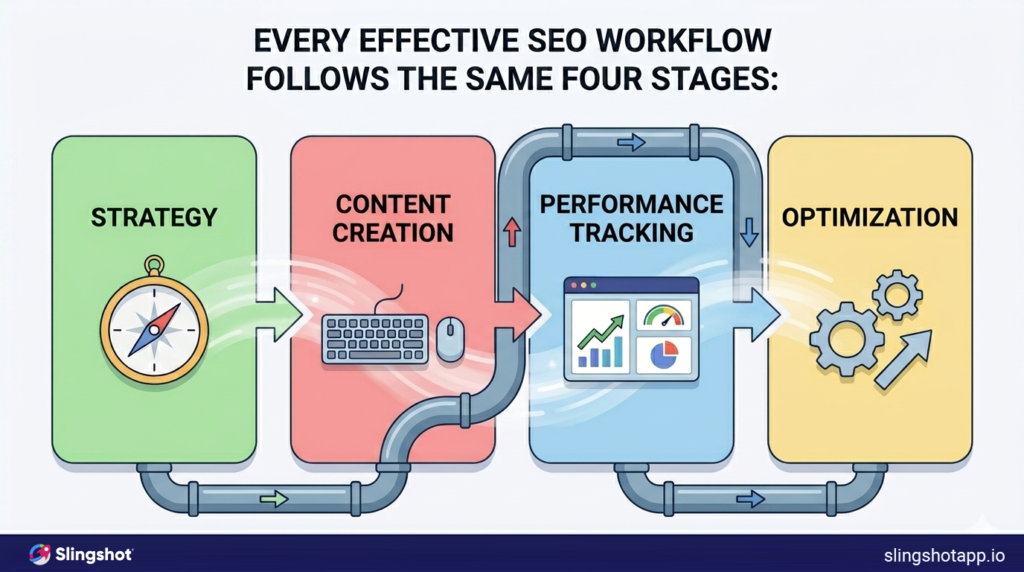
The problem is not understanding these stages. It’s connecting them into a single, repeatable system.
Most teams treat these as separate activities. High-performing teams connect them into one system.
Here’s what a real, execution-focused workflow looks like:
Keywords should never live in isolation.
Each keyword should become a task with:
This is where most workflows fail.
If keywords stay in a spreadsheet, execution depends on memory and manual follow-up.
If it’s not tracked as work, it won’t get done.
Example:
Instead of a keyword list, you create:
That shift turns strategy into execution.
Before content creation begins, every task should have a defined brief:
This ensures:
Without briefs, content becomes inconsistent and harder to scale. It also creates rework. Writers guess. Editors fix. Deadlines slip.
Every stage of execution needs ownership:
And every step needs a deadline.
Without this, content gets stuck in limbo.
High-performing teams remove ambiguity.
They know exactly:
This is where most SEO execution workflows fail. No owner means no accountability.
Execution should follow a consistent process:
This removes friction and increases speed. Instead of reinventing the process every time, teams operate within a system.
Example workflow in action:
| Stage | Owner | Status |
| Keyword assigned | SEO manager | Complete |
| Brief created | Content lead | In progress |
| Draft written | Writer | Pending |
| Review | Editor | Blocked |
This visibility is what drives execution.
Once content is live, the workflow doesn’t end.
Performance should be tracked alongside execution:
This creates visibility into what’s working—and what isn’t.
SEO is not a one-time effort.
Content should be continuously improved based on performance:
Execution → performance → optimization → repeat
This is what turns SEO into a growth engine. Without this step, SEO becomes guesswork.
This is where dashboards matter. You need to see performance tied to each piece of work.
SEO is not a one-time effort. Content should be continuously improved based on performance:
Execution → performance → optimization → repeat
This is what turns SEO into a growth engine. Without this loop, content decays and rankings drop over time.
Even with a defined process, most teams struggle to execute consistently.
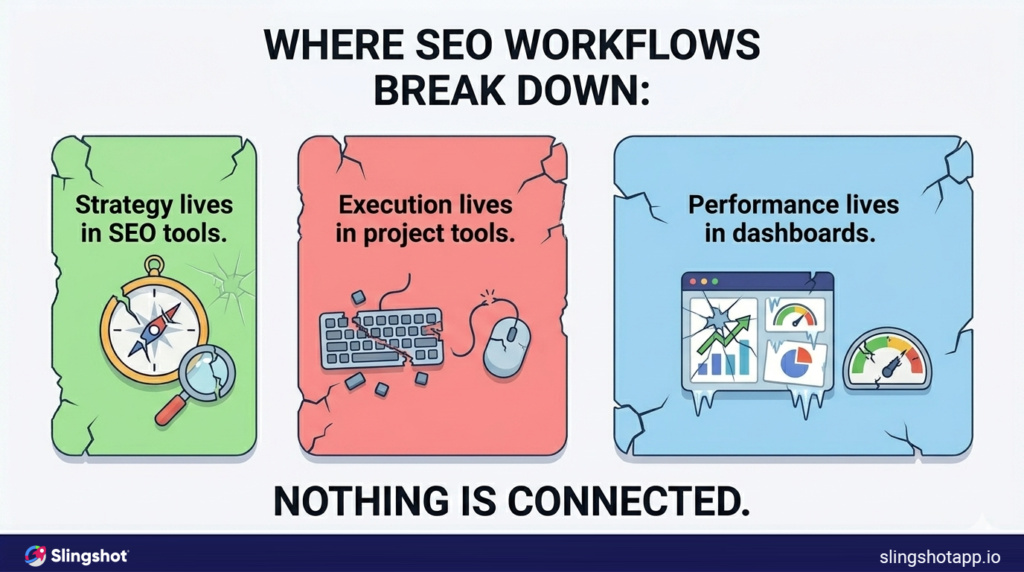
Here’s why:
Strategy lives in SEO tools.
Execution lives in project tools.
Performance lives in dashboards.
Nothing is connected.
Result: work gets lost between systems.
Teams can’t easily see:
So, work slows down. And delays compound across multiple pieces of content.
Without clear responsibility, tasks get delayed or ignored. Everyone assumes someone else is handling it. No one is.
Every piece of content follows a different path. There’s no standard workflow.
That kills scale.
To make SEO execution consistent, you need a system. Not just a process.
Bring strategy, execution, and performance into one place. This eliminates fragmentation and improves visibility.
Your SEO workflow should not live across five different tools.
Define a repeatable workflow for every piece of content.
Consistency is what allows teams to scale output without sacrificing quality.
Everyone on the team should know:
Visibility drives accountability. If work isn’t visible, it won’t move forward.
Don’t separate content from results. Tie performance directly to the work being done.
This is where SEO planning and execution come together.
Templates remove setup time and enforce consistency.
Use templates for:
This is how teams move faster without sacrificing structure.
Most teams don’t need better keyword strategies. They need a better system for executing them because the teams that win with SEO aren’t the ones with the best ideas.
They’re the ones who consistently turn ideas into published, optimized content.
Execution is the multiplier.
Slingshot helps marketing teams turn SEO strategy into execution.
Plan your keywords, assign work, collaborate on content, and track performance in one place. No disconnected tools. No lost work. No missed deadlines.
So, your team doesn’t just plan SEO.
You actually execute it.
An SEO workflow is the process that moves a keyword from research to published content and ongoing optimization.
Strategy, execution, performance tracking, and optimization. In practice, this becomes a structured 6-step execution workflow.
They lack ownership, visibility, and a connected system.
By turning keywords into trackable tasks, assigning ownership, and following a repeatable workflow tied to performance.
SHARE THIS POST


 Return to Blog
 ChatGPT
 Perplexity